How to Prepare for Board Exams: A Practical Study Plan for Better Marks
Board exams can feel stressful, especially when the syllabus is still incomplete or revision has not started properly. The good news is that you do not need to study for 12–15 hours every day to perform well. What matters more is having a realistic study plan, understanding the syllabus, practising questions regularly, and revising multiple times.
This guide explains how to prepare for board exams effectively, including how to make a timetable, complete the syllabus, revise, solve previous-year papers, manage exam stress and improve your answer-writing skills.
How to Start Preparing for Board Exams
The first step is not picking up a textbook and studying randomly. Start by understanding where you currently stand.
Take a notebook and divide your subjects into three categories:
- Strong: Chapters you understand and can solve questions from comfortably.
- Average: Chapters you understand but need more practice.
- Weak: Chapters that you have not studied properly or find difficult.
This simple exercise gives you a clear picture of your preparation.
Instead of spending most of your time studying subjects you already know, give more attention to your weak and average areas.
Check Your Complete Syllabus
Before creating a timetable, go through the latest syllabus provided by your respective board.
Mark:
- Completed chapters
- Partially completed chapters
- Chapters yet to be studied
- Important practical/project work
- Topics that require more question practice
Do not blindly follow an old study plan or random online lists. The syllabus and examination pattern can change, so students should always verify important details from their board’s official information.
Make a Board Exam Timetable You Can Actually Follow
A timetable looks good on paper, but it only works when you can follow it consistently.
Instead of writing something like “I will study 14 hours every day,” create a schedule around your actual routine.
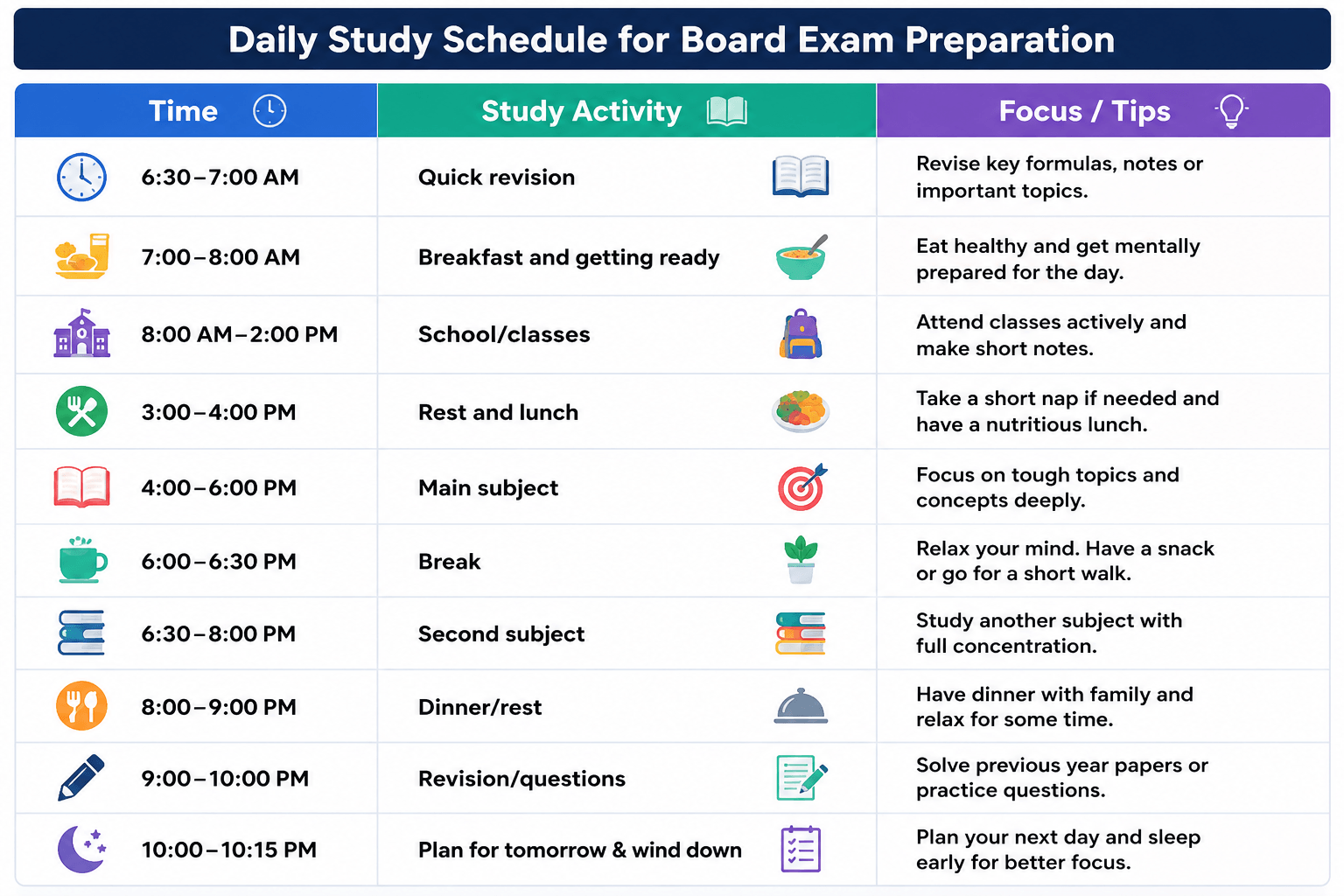
Plan the next day :- The exact timings can be changed according to your school schedule.
The important thing is to create fixed study periods rather than deciding every day when you will study.
Don’t Study for Hours Without a Break
Long study sessions can become less productive when your concentration drops.
Try studying for around 45–60 minutes, followed by a short break.
During the break, avoid getting trapped in social media. A five-minute break can easily become 45 minutes if you start scrolling.
Set Daily Targets Instead of Just Counting Hours
One common mistake students make is measuring preparation by the number of hours studied.
For example:
“I studied for eight hours today.”
That does not tell you how much you actually learned.
A better target would be:
- Complete one chapter
- Revise two previously studied topics
- Solve 30 mathematics questions
- Write one long-answer question
- Complete one previous-year section
This makes your progress measurable.
Use the “3-Task Rule”
At the beginning of each day, choose three important academic tasks.
For example:
Today’s targets
- Finish Chemical Reactions chapter.
- Revise two History chapters.
- Solve one Mathematics sample paper.
If these three tasks are completed properly, the day has been productive.
Focus on Understanding, Not Memorising Everything
Board examinations often require more than simply remembering lines from a textbook.
When studying a chapter, first ask:
What is this topic actually saying?
Try explaining the concept in your own words.
For example, after studying a scientific concept, close the book and explain it as if you were teaching it to a younger student.
If you can explain it without looking at the book, you probably understand it.
If you cannot, go back and study the concept again.
This technique is especially useful for subjects involving concepts, definitions, processes and explanations.
Follow Your Textbook Carefully
Students sometimes collect too many books, PDFs, YouTube videos and notes.
More study material does not automatically mean better preparation.
For many board subjects, your prescribed textbook should remain your primary resource, particularly for understanding the syllabus and important concepts.
Additional books can be useful for:
- Extra questions
- Practice papers
- Difficult concepts
- Revision
- Different explanations
But don’t keep switching between five different resources for the same chapter.
One good source studied properly is usually more useful than several sources studied halfway.
Make Short Notes for Revision
You don’t need to rewrite the entire textbook.
Prepare short revision notes containing:
- Important definitions
- Formulas
- Dates
- Key concepts
- Important diagrams
- Difficult points
- Common mistakes
- Important examples
The purpose of these notes is to help you revise a chapter quickly before an examination.
Use the One-Page Revision Method
After completing a chapter, try to compress its most important information onto one or two pages.
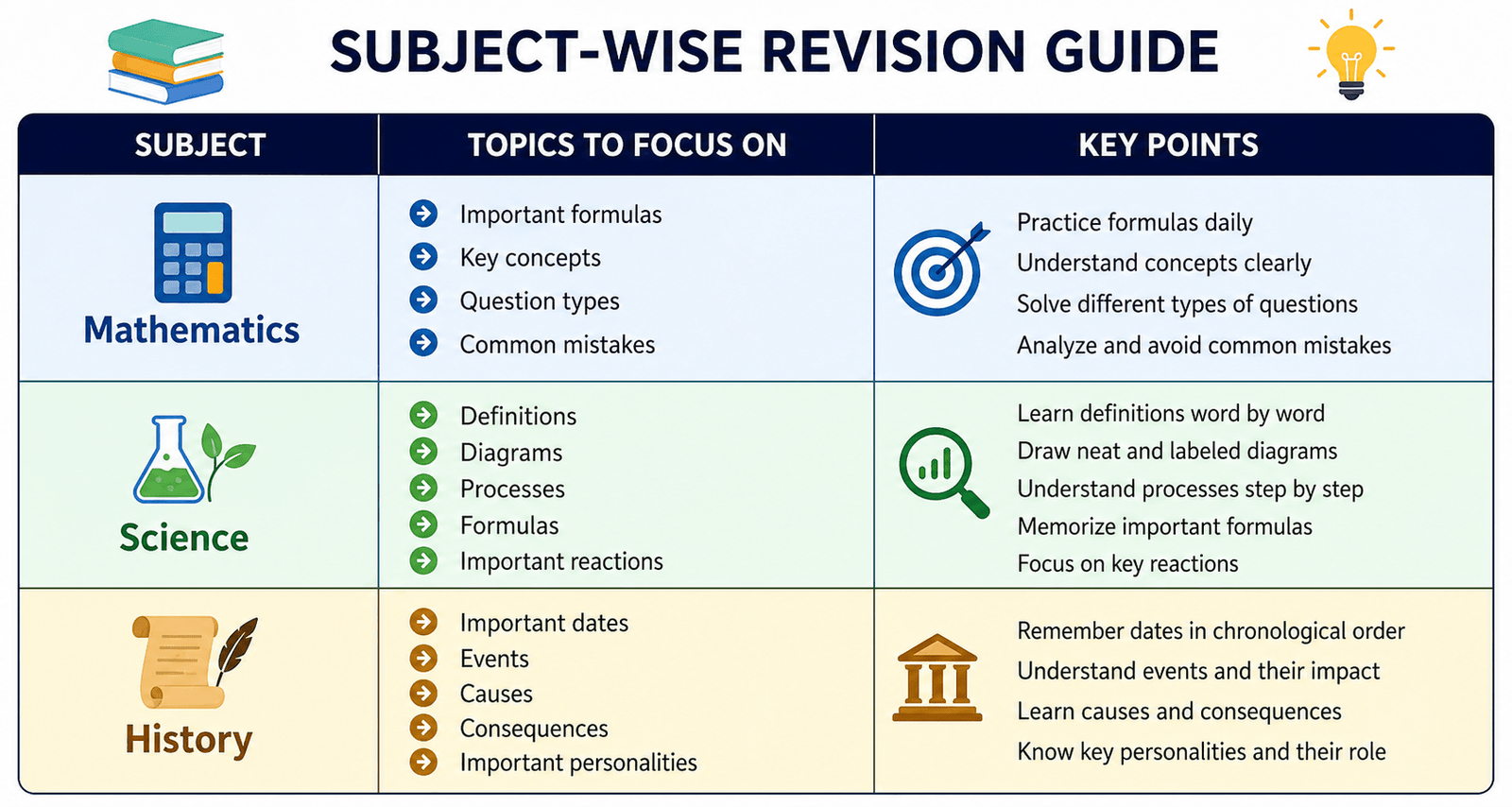
These pages can become extremely useful during the final revision.
Solve Previous-Year Question Papers
Reading a chapter and solving questions are two different things.
A student may understand a chapter but still struggle to write the answer correctly in the examination.
Previous-year papers help you understand:
- The type of questions asked
- How questions are framed
- Repeated concepts
- Difficulty level
- Time management
- Answer-writing requirements
Don’t just read the solutions.
Try solving the paper yourself first.
After completing it, check your answers and identify where you lost marks.
Practise Sample Papers Like the Real Exam
As the examination approaches, start solving complete papers under examination conditions.
Keep the required time limit.
Put your phone away.
Do not check answers while solving.
After finishing, evaluate:
- How many questions you attempted?
- Which questions took too much time?
- Where did you make mistakes?
- Did you leave any question incomplete?
- Was your handwriting readable?
- Did you follow the required format?
- Did you spend too much time on one question?
This practice can improve your confidence significantly.
Learn How to Write Better Board Exam Answers
Knowing the answer is only one part of scoring well. Presenting it clearly also matters.
For Long Answers
Use a simple structure:
Introduction → Main Points → Explanation → Conclusion
Where appropriate, use headings and bullet points.
For Numerical Questions
Show the important steps rather than writing only the final answer.
For Science
Use labelled diagrams whenever the question requires or benefits from one.
For Social Science
Organise answers into clear points rather than writing one extremely long paragraph.
For Languages
Pay attention to:
- Grammar
- Spelling
- Sentence structure
- Format
- Word limits
- Presentation
Always follow the instructions given in the question paper.
Revise Using Active Recall
One of the most useful revision techniques is active recall.
Instead of repeatedly reading the same page, close the book and try to remember the information yourself.
For example, after studying a topic, ask yourself:
- What are the main points?
- Can I explain this concept?
- What are the important formulas?
- What examples were given?
- What questions could be asked from this topic?
Write down what you remember and then compare it with your notes.
This shows you what you actually know rather than what looks familiar while reading.
Use Spaced Revision
Do not leave revision until the night before the examination.
A simple revision cycle could be:
First revision: Within 24 hours
Second revision: After 3–4 days
Third revision: After 1–2 weeks
Final revision: Before the examination
You can adjust this according to your syllabus and examination schedule.
The idea is simple: revisit important information several times instead of trying to remember everything in one sitting.
Give Extra Attention to Weak Subjects
Many students avoid difficult subjects because studying them feels uncomfortable.
Unfortunately, avoiding a weak subject usually makes the problem bigger.
Instead, give it a small daily slot.
For example:
30–45 minutes every day for a difficult subject can be more effective than studying it for six hours only once a week.
Start with the easiest topic in that subject to build confidence, then gradually move towards difficult chapters.
Don’t Ignore Practical and Internal Work
Board preparation is not always limited to theory papers.
Depending on your class, board and subjects, practical examinations, projects, internal assessments and other components may contribute to the final result.
Keep track of:
- Practical records
- Projects
- Assignments
- Viva preparation
- Practical files
- Internal assessment requirements
Complete these tasks before the final revision period becomes too busy.
How to Avoid Phone Distractions While Studying
Your phone can become one of the biggest obstacles during exam preparation. You don’t necessarily have to stop using it completely. Instead of following these below:-
- Keep the phone away during study sessions.
- Turn off unnecessary notifications.
- Use website/app blockers if needed.
- Watch educational videos only when they serve a specific purpose.
- Avoid opening social media during short breaks.
A useful rule is: Study first, entertainment later.
Once your daily targets are completed, you can enjoy some free time without feeling guilty.
Take Care of Sleep and Health
Studying late into the night may feel productive, but regularly sacrificing sleep can make concentration and memory more difficult. Try to maintain a consistent sleep schedule :-
- Eat regular meals.
- Drink enough water.
- Take short breaks.
- Get some physical movement during the day.
- Avoid studying continuously for several hours without rest.
Exam preparation is a long process. Your goal is not to be productive for two days; it is to remain consistent for several weeks.
What to Do If You Have Very Little Time Left
If your board exams are approaching and your syllabus is incomplete, don’t panic.
Start by prioritising.
Step 1: Check the syllabus
Identify exactly what remains.
Step 2: Prioritise important topics
Start with chapters and concepts that are important for your preparation and that you can realistically complete.
Step 3: Study the basics
Do not spend hours trying to master one extremely difficult topic while leaving many manageable topics untouched.
Step 4: Practise questions
Move quickly from learning to solving.
Step 5: Revise repeatedly
Short, focused revision is better than repeatedly reading entire chapters.
Step 6: Solve at least a few complete papers
This will help you understand your preparation level and improve time management.
Common Board Exam Preparation Mistakes
Avoid these mistakes during your preparation:
1. Making an unrealistic timetable
A timetable with 12–15 study hours may look impressive but can be difficult to maintain.
2. Studying only your favourite subjects
Strong subjects need revision, but weak subjects need attention too.
3. Watching endless “study motivation” videos
Planning is useful, but actual studying produces results.
4. Collecting too many resources
Avoid constantly changing books and notes.
5. Ignoring previous-year papers
Question practice is an essential part of preparation.
6. Starting revision too late
Revision should happen alongside syllabus completion.
7. Sacrificing sleep regularly
Being exhausted is not a reliable exam strategy.
A Simple 30-Day Board Exam Preparation Plan
If you have around one month remaining, you can divide your preparation into four phases.
Period
Main Focus
Days 1–10
Complete remaining important chapters
Days 11–18
Finish syllabus + chapter-wise questions
Days 19–25
Revision + previous-year papers
Days 26–30
Full-length papers + final revision
Adjust this plan according to the number of subjects, remaining syllabus and examination timetable.
The important point is to avoid spending the entire final week learning new material.
Try to enter the final days with most of the syllabus already covered.
What Should You Do the Night Before the Board Exam?
The night before an examination is not the right time to start an entirely new chapter unless absolutely necessary.
Instead:
- Revise important formulas and definitions.
- Review short notes.
- Check important diagrams or formats.
- Pack your examination essentials.
- Check the reporting time and examination instructions.
- Sleep properly.
Don’t turn the night before the exam into an all-night study session.
What to Do in the Examination Hall
Once you receive the question paper:
- Read the instructions carefully.
- Check the number of questions.
- Plan your time.
- Start with questions you can answer confidently, if the paper instructions allow it.
- Keep an eye on the clock.
- Write answers clearly.
- Leave some time for checking.
- Review unanswered questions before submitting the paper.
If one question is difficult, don’t let it consume the time needed for several easier questions.
Frequently Asked Questions
How many hours should I study for board exams?
There is no single number that works for every student. The quality and consistency of your preparation matter more than simply counting study hours. Set realistic daily targets and maintain regular revision.
When should I start preparing for board exams?
Ideally, preparation should begin well before the final examination period. However, even if you have limited time, a focused plan can help you make significant progress.
Should I study from the textbook or reference books?
Start with your prescribed textbook and syllabus. Use reference books mainly for additional practice and clarification when required.
Are previous-year question papers important for board exams?
Yes. They help you understand question patterns, practise time management and identify topics that need additional preparation.
How can I remember what I study?
Use active recall, spaced revision, practice questions and short revision notes instead of relying only on repeated reading.
What should I do if I am weak in Mathematics?
Identify the chapters and question types causing difficulty. Learn the basic concepts first, then practise questions from easy to difficult levels. Regular practice is more useful than studying Mathematics only occasionally.
Is studying at night better for board exams?
Not necessarily. The best study time depends on when you can concentrate effectively. Choose a schedule that suits your routine while maintaining adequate sleep.
Should I stop using social media completely during board exams?
You don’t necessarily have to. However, if social media repeatedly interrupts your study sessions, temporarily limiting access can make it easier to maintain concentration.
Final Thoughts
Preparing for board exams is not about studying every waking hour. It is about knowing what to study, studying it properly, revising it repeatedly and practising how to write the examination.
Start by understanding your syllabus. Create realistic daily targets, focus on weak areas, practise previous-year papers and revise using active recall. At the same time, don’t ignore sleep, food and short breaks.
Most importantly, don’t compare your preparation with another student’s timetable. Someone else’s ten-hour study schedule may not be right for you.
A consistent three to six hours of focused preparation can be more valuable than spending an entire day with a book open but little concentration.
Start with today’s three most important tasks, complete them properly, and build from there. Small, consistent progress can make a big difference by the time your board exams arrive.
Sources & References
This article draws on research and guidance from internationally recognised education, psychology and assessment organisations:
American Psychological Association (APA) — Research-tested approaches to studying and preparing for examinations, including retrieval practice and effective learning strategies.
APA – Six Research-Tested Ways to Study Better
OECD – PISA — International research on students’ learning strategies, self-monitoring, critical thinking and learning behaviours.
OECD – PISA 2022 Results: Learning Strategies and Attitudes for Life
Education Endowment Foundation (EEF)— Evidence-based guidance on metacognition and self-regulated learning, including planning, monitoring and evaluating learning.
EEF – Metacognition and Self-Regulation
Education Endowment Foundation (EEF) — Guidance on applying metacognitive and self-regulated learning strategies in education.
EEF – Metacognition and Self-Regulated Learning Guidance
Editorial Note
This article provides general educational guidance based on research and publicly available information from recognised education and psychology organisations. Examination rules, syllabuses, marking systems and assessment methods vary between countries, education boards and academic years. Students should check their respective examination board’s latest official information for specific examination requirements.
About the Author
Satinder Pal Singh is a content writer with over 6 years of experience researching and writing informative content related to careers, jobs, education and career guidance.